

Erich Heckel
Döbeln/Sachsen
1883 -
Radolfzell/Bodensee
1970
Heckel began studying architecture in 1904 at the Technical University in Dresden, but left the university again one year later. Heckel prepared the ground for Expressionism when he founded the artist group "Die Brücke" together with his friends Karl Schmidt-Rottluff, Fritz Bleyl and Ernst Ludwig Kirchner in 1905.
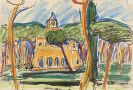
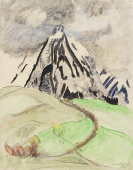
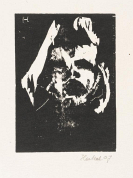
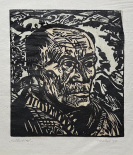
The artist now concentrated on various printing techniques such as woodcut, lithograph and engraving. He produced landscapes in dazzling colours. In the autumn of 1911 Heckel moved to Berlin. He was acquainted with Max Pechstein, Emil Nolde and Otto Mueller who had joined the "Brücke" artists and now met Franz Marc, August Macke and Lyonel Feininger.
In 1912 Erich Heckel painted the murals for the chapel of the "Sonderbund Exhibition" in Cologne together with Ernst Ludwig Kirchner. "Die Brücke" was dissolved in the following year and Gurlitt arranged Heckel's first one-man-exhibition in Berlin.
Erich Heckel spent the years 1915 - 1918 in Flanders as a male nurse with the Red Cross and then returned to Berlin where he remained until the beginning of 1944. Heckel spent most summers on the Flensburger Förde while his many travels took him to the Alps, Southern France, Northern Spain and Northern Italy.
729 of his works were confiscated in German museums in 1937 and his studio in Berlin was destroyed in an air raid in Berlin shortly before the end of the war, destroying all his printing blocks and many of his works. Heckel subsequently moved to Hemmenhofen on Lake Constance.
In 1949 he was appointed professor at the "Akademie der Bildenden Künste" in Karlsruhe, a post that he held until 1955. During this decade the still life became an increasingly important subject in Heckel's work. His style was now calmer, more balanced with an almost lyrical atmosphere.
Erich Heckel was honoured with exhibitions in numerous German cities in 1953 to celebrate his 70th birthday - and again ten years later on his 80th birthday. Heckel was also awarded numerous prizes: the "Kunstpreis" of the city of Berlin (1957), of the state of North Rhine-Westphalia (1961) and the "Großes Bundesverdienstkreuz" (1956).

Would you like to sell a work by Erich Heckel?
Infos for seller


Starting bid: 5,500 EUR